Electronic batch record: finally building trust in traceability

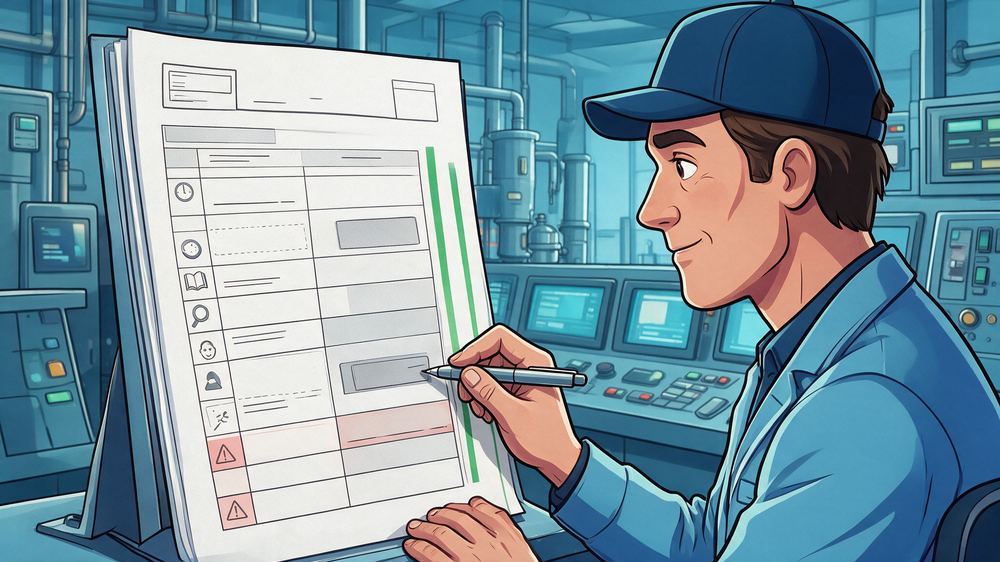
Have you ever seen a batch record with sixty tick boxes on the same page? Now imagine filling it in on a touchscreen. Before launching the tender to choose your software, do some tidying up: an electronic batch record doesn’t fix the flaws of paper, it freezes them.
1. Put the batch record back in its role: traceability
Reviewing a batch record isn’t checking that production was compliant. It’s checking that the batch’s memory is complete: identification of materials, adherence to the frequency of in-process checks, duration of a mixing step. Production compliance is ensured by other means: training and qualification, equipment qualification, in-process checks.
If you wait for the record review to discover that an unreleased material was used, it’s too late. Setting out this principle from the start avoids turning the electronic record into a checking factory.
2. Remove unnecessary data
In our simplification work, we generally identify 30 to 60% unnecessary data. In some cases, this amounts to asking for a data item every twenty-five seconds from operators who also have to run their machines. The classics: repeated signatures for each step, dates and times written down several times a day, values copied from a label or a weighing ticket.
On paper, this data costs filling-in time. In an electronic system, it also costs configuration. Yet the system can do a lot on its own:
- automatically identify the logged-in person;
- time-stamp each step;
- check an expiry date or status in the ERP, retrieve a weight or a pH directly from the instrument;
- reserve electronic signatures and double checks for critical steps only, so as not to multiply password entries.
3. Follow shop-floor reality
On paper, people get used to it: start on page 2, move to page 5, then there’s a value to copy onto page 12. In an electronic record, this back-and-forth becomes impossible, because a step often can’t start until the previous one is finished. So you need to go to the shop floor to observe the actual order of operations, harmonise practices between teams, and build a journey designed for the operator.
4. Build a block strategy
An electronic record isn’t a document that runs from start to finish, but an assembly of reusable functional blocks. Rather than creating one block per material to be weighed, you create a “weighing” block (checking the material and its expiry date, tare, weighing, label) in which the material and quantity are variables. Likewise, you don’t create “cycle 3245 on autoclave B32”, but a “starting an autoclave cycle” block.
The benefits are immediate: faster build, consistency between products, and simpler updates, since changing one block benefits every record that uses it.
5. Prepare review by exception from the start
The electronic record can check value ranges itself, prevent out-of-sequence steps, enforce double checks and record every action. Routine compliance is therefore guaranteed by the system. Human review can focus on what departs from the planned scenario: an out-of-tolerance value, a repeated step, a comment, a change in the audit trail.
This review by exception is prepared at the design stage: which steps can be reviewed automatically, which critical parameters must always be reviewed, where is real-time authorisation needed in case of an anomaly?
In summary
Digitalising a batch record isn’t scanning pages or ticking boxes on a screen. It’s simplifying, structuring and letting the system handle routine, to make life easier for operators and reviewers while guaranteeing a complete, reliable batch memory.